February 12, 2025, The Rock and Roll Hall of Fame releases the nominees to be voted for induction. The list included Chubby Checker, Billy Idol, Outkast, Phish, and Cyndi Lauper.
It’s not unusual for the Rock and Roll Hall of Fame to nominate a motley crew. The inclusion of Cyndi Lauper is particularly noteworthy.
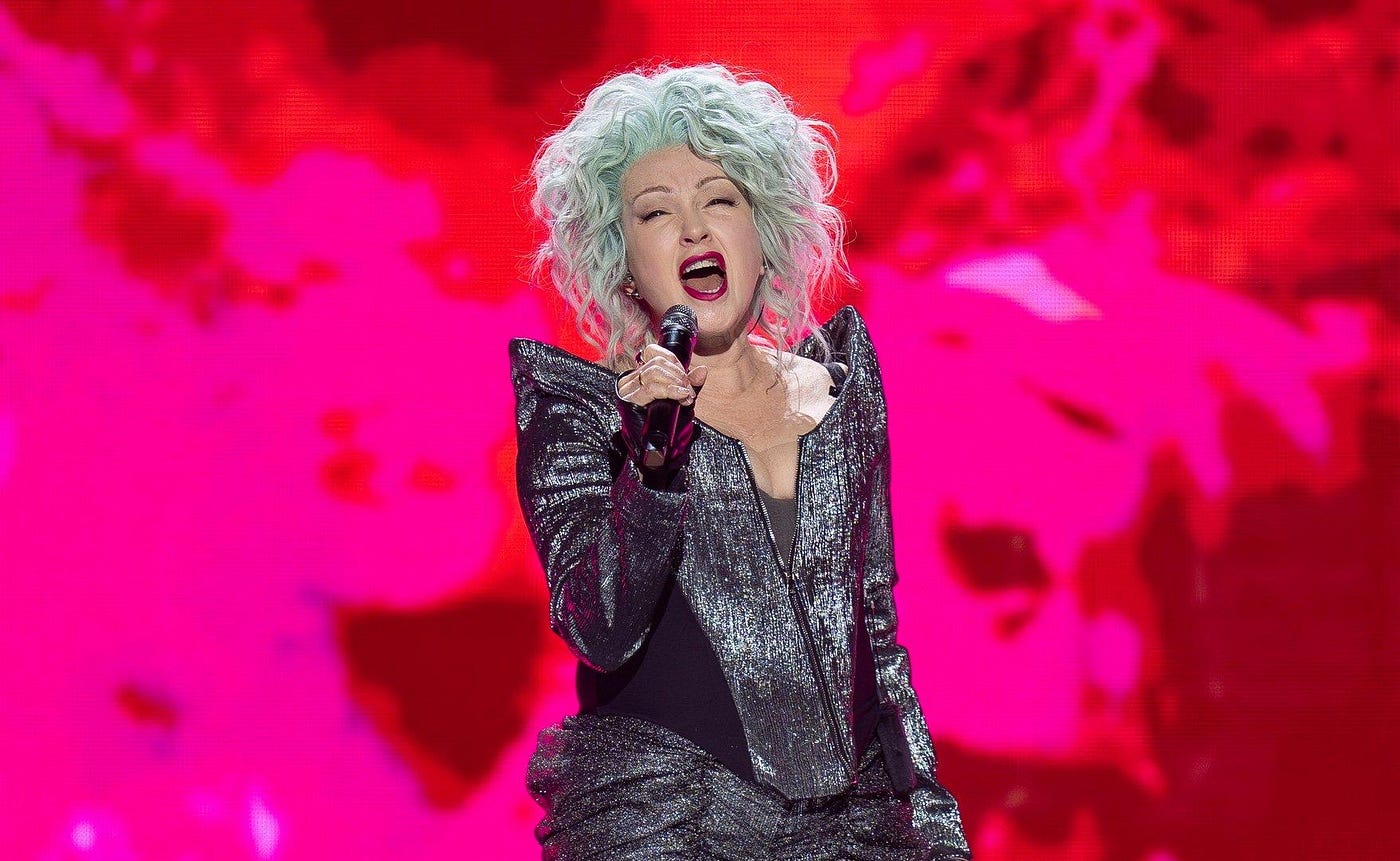
Reading History As Contemporary Narrativity
Those not following her career since the late 1980s, Lauper has been active performing, composing, acting, and working as a civil activist. Her resume has expanded to include a June 4, 2024, Alison Elwood-directed Paramount+ documentary, Let the Canary Sing, and musicals.
“[Lauper won a] Tony and Grammy awards in 2013 for her score for the blockbuster musical “Kinky Boots.” (She announced onstage that her musical version of the 1988 movie “Working Girl” would be premiering at the La Jolla Playhouse in 2025.)” (The San Francisco Chronicle, November 2024).
The theme of “Kinky Boots” follows Lauper’s personal agenda to support marginalized communities, particularly the LGBTQ+ community.
“‘Kinky Boots’ — about a drag queen who saves a struggling shoe factory — won six Tony Awards including best musical and best original score. (Lauper was the first woman to take the score prize by herself.)” (Los Angeles Times, October 8).
About “Working Girl,” her next musical, is the long-anticipated follow-up to “Kinky Boots.” Again, Lauper calls into question gender discrimination and injustice. Compiling multiple female voices is a consistent strategy Lauper uses to articulate a universality of feminism, which could easily fall back on privileging white, non-ethnic middle-class women.
“Set to begin previews on Oct. 28, “Working Girl” has been in development since at least 2017. “It’ll go this way, get a little pear-shaped, then it’ll come back this way,” Lauper says of the show, which is based on Mike Nichols’ 1988 movie about a secretary navigating the male-dominated business world. The music pulls from the ’80s sounds Lauper knows as well as anyone; to help her out, she brought in Rob Hyman, with whom she wrote “Time After Time,” and Cheryl James of the rap group Salt-N-Pepa, which will also be inducted into the Rock Hall next month” (Los Angeles Times, October 8).
A life filled with homelessness, putting herself through college as an art major, a disastrous job as a secretary, waitressing, and working in second-rate bands who nearly had a start, it was her last-ditch try to release a solo demo, which caught the attention she had been working to gather.
“Singer Cyndi Lauper’s 1983 breakthrough was originally written by Robert Hazard from a male perspective (1979). Lauper flipped the script with some lyric changes for her debut album “She’s So Unusual.” But far from being a flippant party tune, it has become Gen X’s version of Helen Reddy’s “I Am Woman” and the namesake for Lauper’s Girls Just Want to Have Fundamental Rights Fund at the Tides Foundation” (The San Francisco Chronicle, November 2024).
Lauper’s invitation to the Rock and Roll Hall of Fame comes after years of the organization being criticized for the lack of inclusion of marginalized and female artists. With the removal of Jann Wenner, the Rolling Stone magazine founder, who was booted from the board of the Rock & Roll Hall of Fame in 2023 for negative comments about minority and female artists, Lauper accepted the invitation from the Rock and Roll Hall of Fame.
“[S]he has no qualms about accepting the invitation of the Rock Hall, which in the last few years has significantly diversified its ranks and its leadership along race and gender lines” (Los Angeles Times, October 8).
Fun-damentally Expressing Rights
‘Girls just want to have fun-damental rights’ has been adopted by contemporary feminists, in particular those from Gen X, as an anthem against ongoing socio-political and economic suppression of women. As a long-standing advocate for LGBTQ+ rights, Lauper has not allowed her age of 72 years to slow her work.
Cyndi Lauper Biography: Icon of the feminist movement, NPA Discovery, August 2024.
“Cyndi Lauper is an American music icon, famous for her distinctive voice and rebellious fashion style. Born in 1953, she quickly became a music phenomenon in the mid-1980s with her debut album “She’s So Unusual”. Songs like “Girls Just Want to Have Fun” have become classic hits, inspiring generations. In addition to her music career, Cyndi Lauper is also an active social activist, especially for the LGBT community. She has always been known for her free spirit and is one of the most influential female artists in modern music history” (NPA Discovery, YouTube, August 2024).
Cyndi Lauper On Pop, Feminism, Women’s Rights And Her Resurgence In The Streaming Era, MSNBC, October 2022.
Hermeneutical Analysis of Pop/Culture
“More than 40 years later [of the release of “Girls Just Want To Have Fun”], the Best New Artist Grammy-winner, Tony-winner, and Rock & Roll Hall of Fame nominee, who will embark on her farewell tour this year [2024], “never gets tired of singing that song live.” But, bittersweetly, “Girls” resonates perhaps even more deeply today. After Lauper noticed protesters carrying “Girls Just Want to Have Fundamental Rights” signs at the Women’s March in 2017, she co-designed two T-shirts with that slogan to raise money for True Colors United (her organization that aids homeless LGBTQ+ youth), Planned Parenthood, and later the Girls Just Want to Have Fundamental Rights Fund, which Lauper launched in 2022 in response to the overturning of Roe v. Wade” (Musical Times, June 2024).
The interpretation of pop/culture that Lauper provides encompasses multiple generations. Coming through the third wave of feminism (1990s-2000s), hallmarked by the involved intersectionality of socio-political, economic issues, and how these have maintained a male-centered privilege, Lauper is working in the current fourth wave of feminism (2000s-present), contextualized by gender inequality and applied activism. Lauper’s critical feminist discourse is articulated in her works through revision, inversion, and deconstruction of social hetero-centristic norms. It is Lauper’s reading of these intersectionalities that sustains her works for feminist application and discourse.
“As Patricia Hill Collins has written in her foundational text Black Feminist Thought: Knowledge, Consciousness and the Politics of Empowerment, “Intersectionality refers to particular forms of intersecting oppressions, for example, intersections of race and gender, or of sexuality and nation. Intersectional paradigms remind us that oppression cannot be reduced to one fundamental type, and that oppressions work together in producing injustice” (2009, p. 21)” (qtd. by Matthew Valens, Duke University, 2017).
For Lauper, this reading of intersectionality provided by Collins is the launching pad for her critical feminist work.
Working along the lines of support for a younger generation, Lauper employs a pop-punk fashion style that borrows from multiple fashion eras, juxtaposed and represented as a commentary on socio-political, economic male-centered norms. The female body, the visceral space-place, for Lauper is the loudspeaker through which her fashion style is broadcast, amplifying the multiple eras of feminism.
Not limiting her physical analysis of pop/culture, Lauper creates an identity through which she navigates the marketing essentialism of the female body and expression. Her operations push against the recording industry’s assumptions and qualified image of a female musician/artist. By not succumbing to a male-centrist entertainment industrial complex, Lauper elects to promote her space-place analysis of culture through the investment of fashion gender stereotypes.
Lauper wears deconstructive agency. She illustrates the strata of feminism through fashion and style. In doing so, she creates a postmodern critique of pop/culture from a feminist view. The inclusion of multiple female representations in her videos (ex, “Girls”), Lauper creates a safe space for body politics. Further, as Lordi and Tammy Kernodle state, Lauper creates “alternative methods of knowledge building” (Kernodle, 2014, p. 32) (qtd. by Matthew Valens, Duke University, 2017). This action is seen in her feminist calling card song, “Girls.”
The constellation of Lauper’s performing aesthetic (lyrics, sound, body politic, space-place) opens a contemporary critique of pop/culture for a postmodern feminist analysis. Lyrically, Lauper expresses a counternarrative to the assumed male-dominated artistic norms. The choice of sound for her works is an emboldened multi-genre, globalized soundscape. These two points, along with the critical reading of Lauper’s post-modern feminist critique, outline a working feminist dynamic dialogue. Supplanting these perspectives in various contexts, these critical feminist points stand firm and talk back to the controlling agent. Lauper reads the heternormativity in the music business/industry through her dynamic critical feminist lens. The example result is “Girls,” which, based on these living agents.
In an interview with the BBC, cited in the Daily Mail, Lauper noted her testimony of becoming a feminist.
“I burnt my training bra at the first women’s demonstration at the Alice in Wonderland Statue…I was there. And I burnt it not just for me, but for my mother, and my grandmother, right? The women whose shoulders I stand on” (The Daily Mail, June 2024).
Lauper’s music game is strong, but her most important legacy is perhaps True Colors, the 30-bed supported residence in Harlem she co-founded after learning that 40 percent of all homeless youth identify as LGBT. A long-time advocate for the advancement and rights of the LGBT community, Lauper has been around long enough to know that history isn’t a straight line — it’s a circle.
“You have to understand that I grew up in the Civil Rights Movement, so I heard all the stories about why you couldn’t have a black person live next door… So when I grew up and I started to hear all this stuff about the LGBT, I’m like, ‘Oh, I heard this record before, and it’s a crock.’ Because guess what? Everybody is different from everybody else. Once you’re taking civil rights away from people, then your civil rights are up for grabs, too.” (qtd in The Daily Mail, June 2024).
“True Colors,” as a song and location for community support, is a culmination of Lauper’s decades of work as an activist fighting homelessness among LGBTQ+ youth and combating efforts to restrict women’s reproductive rights” (The Los Angeles Times, October 8).
Speaking of her socio-political discourse, Lauper states that her founding actions operate for equity, justice, and freedom for all, regardless of race, creed/ethnicity, color, economic status, housing location, or identity.
“As she explains it, equality is key. “So I say if we’re all free, we’re all free. And at some time they’ll pay women as much as they pay men for the same friggin’ job. The way I am, I burned my training bra at the first women’s demonstration, so I’m very much a feminist. So when you come from that background, you kinda already see how important civil liberties are. So yeah, I stick up for [LGBT], I feel that they are the voiceless, especially the homeless LGBT youth, because they’re the most vulnerable. And who is going to stick up and open their big mouth? I got a big mouth. I’m not afraid of nuthin’.” (Nylon, May 2016).
Of her activism, Lauper justifies her actions and musical narratives as a location for change.
“Lemme tell you something: I had Planned Parenthood, Human Rights Campaign, the League of Women Voters — that was our little village. I had information for people to help themselves if they need help, and I had information about the SAVE Act that they’re trying to put over on the American women so that if you got married and you have your husband’s name and it’s not the same name on your birth certificate, you can’t vote.” (Supporters of the legislation, which would require people to prove they’re U.S. citizens in order to vote, say that a birth certificate is just one form of eligible identification.)” (Los Angeles Times, October 8).
Giving “Girls” Space-Place
The song “Girls Just Want To Have Fun” has become an anthem of the fourth wave of feminism.
“[S]he [Lauper] remade Robert Hazard’s somewhat pouty “Girls Just Want to Have Fun”…as a kind of exuberant liberation cry” (The Los Angeles Times, October 8).
“Girls Just Want to Have Fun,” was actually a cover of a 1979 hyper-masculine punk bop by Philly new waver Robert Hazard.
“When Rick Chertoff, the producer of Lauper’s debut album She’s So Unusual, took the promising new Portrait Records signing to see Hazard play a Philadelphia club, Lauper was totally turned off by Hazard’s peformance of “Girls Just Wanna Have Fun” (note his title’s more casual spelling), which he sang from the point of view of a girl-crazy, slightly slut-shaming bad boy. Right then and there, Lauper told Chertoff that she would never record the song, as Chertoff had proposed” (Musical Times, June 2024).
A typical masculine-centered pop song, “Girls,” was written from a male perspective about a man’s lust for women. Lauper, extending her feminist ideology, would not participate in this expression. It would take additional producers and collaborators who invested faith in Lauper’s revision that helped launch “Girls” to a cultural iconic work.
“It was only after Chertoff and Lauper’s other She’s So Unusual collaborators, Rob Hyman and Eric Bazilian of the Hooters, were, as Lauper tells Music Times, “all game and kind enough to let me have my head and my ideas,” that the slightly retitled “Girls Just Want to Have Fun” became a feminist anthem” (Musical Times, June 2024).
Sonic and narrative revisions, Lauper escalated her version of “Girls” to include what could be a cacophony of sounds as a fabric signifying on multi-ethnic sounding identities. Framed from a female perspective, “Girls” flipped the script on the earlier male-centered, misogynistic work.
“Lauper eventually “understood how I could sing from my point of view and make it a call to solidarity for women. The parts that were very masculine and didn’t pertain to what I wanted to say, I cut out.” She not only switched up Hazard’s misogynist lyrics (with his blessing), but also suggested the bright, summery, joyful arrangement, which included Coney Island-inspired carnival organs and modern hip-hop snare beats” (Musical Times, June 2024).
Intersectionality in the hands of Lauper reads equally as inclusivity. Emboldened by earlier female musicians, the civil rights movement, and the earlier waves of feminism, Lauper has been critical of including multiple women’s voices, identities, and appearances in her work. “Girls” illustrates this point and was a shocking hit through record sales, radio play, and MTV.
“Lauper’s instincts [on the musical and lyric revisions] were correct, and her radical remake of “Girls” connected with fans, many of them female and/or queer, who felt emboldened by its message. “I didn’t know it would be so well-received, of course, but I really wanted every woman to hear that song and think about their power. That’s also why it was very important that I had women of all colors in that [music] video, so that every little girl, wherever she was from, could see herself in that video,” Lauper explains” (Musical Times, June 2024).
Postmodernism As Activism
Lauper contextualizes a postmodern representation of pop/culture (sound, body politic, space-place, lyrics). Examining Lauper’s musical and activist history, she paved the way for contemporary female artists such as Lady Gaga, Katy Perry, Nicki Minaj, Chappell Roan, P!nk, and Gwen Stefani (Nylon, May 2016). It’s Lauper’s postmodern style, ethic, and approach to civil rights, in particular, youth homelessness, and the LGBTQ+ community.
Coupled with her dynamic style/fashion, Lauper inverts socio-political norms. Lauper’s use of space-place in her videos brought subtle attention to how feminism was catalogued and remained codified by masculinity in the 1980s-1990s. Capturing space-place, by inserting herself in various localized and unorthodox environments, Lauper challenges the limits of the female identity, being subjective and submissive. Lauper brings an underscored attention to heteronormative control by projecting a punk-ish fashion style and visceral manipulation of space-place. This disturbs social-political norms while affording liberty to the female identity. Lauper’s postmodern rhetoric is narrated through her work, videos, fashion style, and persistent commitment to questioning the statement of “freedom for all.”
Through the arc of her career and socio-political agenda, Lauper capitalizes on the mythological understanding of pop culture to deconstruct contemporary feminist theory. Framed on her personal agenda to promote a call to action for disenfranchised communities, Lauper operates at the core of the fourth wave of feminism, avoiding the pitfall of privileging white, non-ethnic, middle-class women. This dynamic balancing has sustained Lauper’s works throughout the decades and gives credit to how her works are relevant for multiple generations and socio-political, economic causes.
In her words, Lauper succinctly defines the trajectory of her career, personally and professionally; “I’m very political,…Always was” (The Los Angeles Times, October 8).
Alan Lechusza Aquallo


Leave a comment