The song “American Woman” by the Canadian band Guess Who was released in 1970. The song has a complicated profile. The band members are torn on the exact meaning of the song. One says it’s a rejection of American women in favor of Canadian women. Another says it’s an anti-war protest song, specifically about the Vietnam War. This difference allows for further critical reading of the track, aligning the included signifiers in the current socio-political discourse.
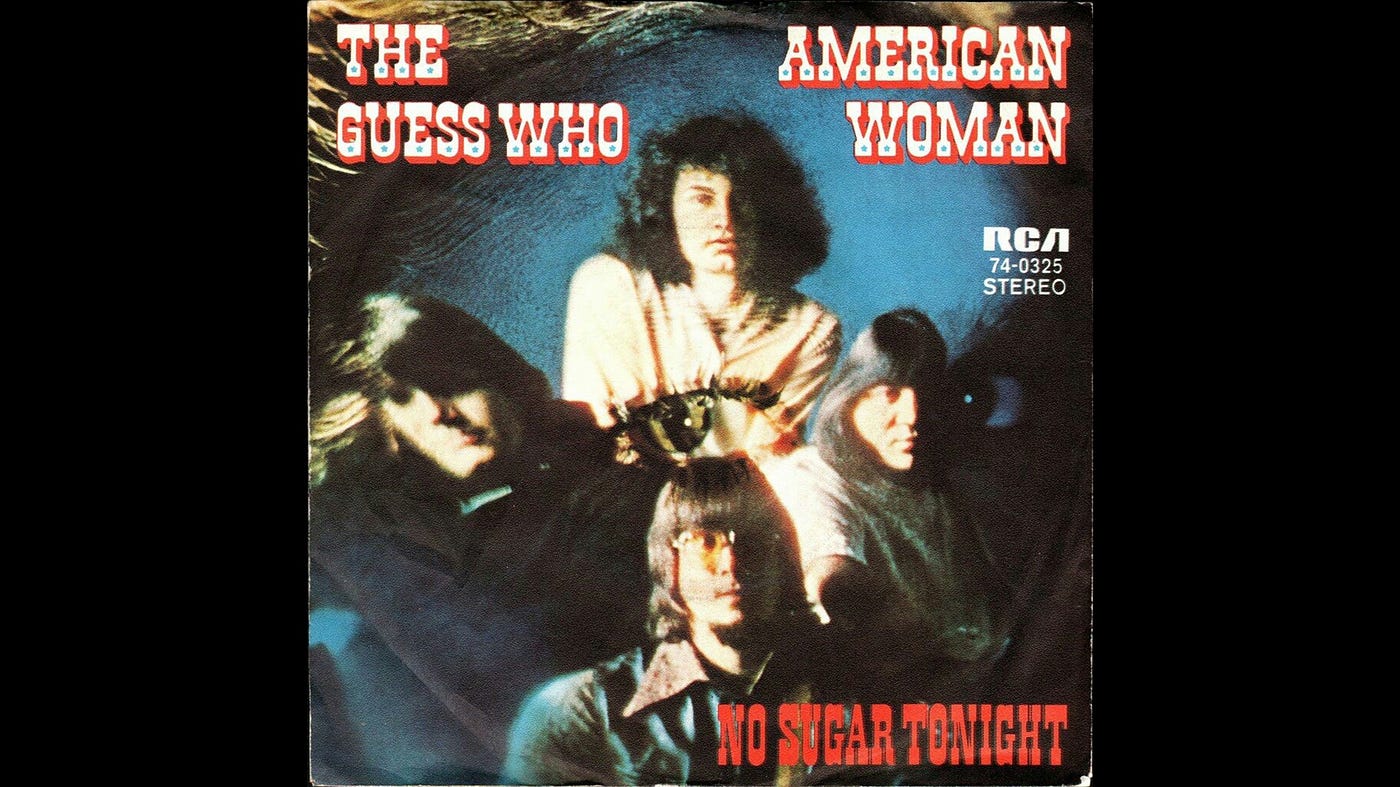
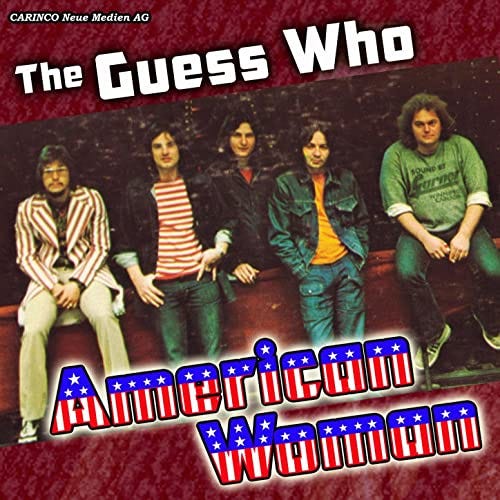
Guess Who, “American Woman” (1970).
Guess Who, “American Woman” (album version, 1970).
An Approach As A Counterpoint To Critics
Using the lyrics as the basis for the analysis, I seek to see how these improvised words frame a contemporary commentary on culture, society, and politics. In doing so, the result argues against the popular belief that Rock music has died.
One argument for why Rock music is dead speaks to the lack of progression in Rock’s lyrics. Using the same, unchanged themes, critics who claim that Rock is dead fall back on this line of attack. The lack of progress in narrative formalizes a predictable process and structure in lyrics and song form overall. Rock’s inability to remain current with the growing trends in narrative, structure, and expression further frames claims on the death of Rock.
The song “American Woman” follows a standard three-verse, chorus, guitar solo structure. This alone confirms cultural critics set on seeing Rock die an immediate death. However, when such critics neglect to apply the narrative with a contemporary reading, the knee-jerk conclusion to coin Rock as a dead musical genre turns a blind eye to the opportunity to examine this work in a new and different cultural climate.
The analysis provided follows this trajectory, contextualizing the song, primarily the lyrics, in a contemporary framework as a commentary on the current American socio-political climate. This methodology may not update the 1970s song, but it does represent the song in a context; otherwise, it would not be involved.
A Brief Confusing History
“The music and lyrics of the song “American Woman” were improvised on stage during a concert in Southern Ontario (the Guess Who guitarist, Randy Bachman, recalled it being at a concert in Kitchener, although Burton Cummings, the lead singer, said it was at the Broom and Stone, a curling rink in Scarborough)” (Wikidepida, September 13).
Already, we see the dynamics of the song being born with a complicated identity. This would not cease as band members give varying understandings of the core meaning and intent of the song.
Bachman was fixing a guitar string, strumming a line, which became the signifying riff and rhythm of the song. Continuing this riff while the band took the stage, a jam session unfolded where Cummings improvised the lyrics.
“They noticed a kid with a cassette recorder making a bootleg recording and asked him for the tape. They listened to the tape and noted down the words that Cummings had extemporized, and which he later revised” (Wikipedia, September 13).
This unexpected history led to a song with multiple identities.
“Cummings, who composed the lyrics, said in 2013 that they had nothing to do with politics. “What was on my mind was that girls in the States seemed to get older quicker than our girls and that made them, well, dangerous. When I said ‘American woman, stay away from me,’ I really meant ‘Canadian woman, I prefer you.’ It was all a happy accident” (Wikipedia, September 13).
This reading of the song, one which is literally about women, specifically Canadian women who are seen as desirable, whereas American women are viewed as detestable, has found a comfortable location in American pop culture. The counterpoint to this reading is the understanding of the song as an anti-war protest song.
“Bachman expressed the view in 2014 that it was “an anti-war protest song”, explaining that when they came up with it on stage, the band and the audience had a problem with the Vietnam War. Said Bachman: ‘We had been touring the States. This was the late ’60s, one time at the US/Canada border in North Dakota they tried to draft us and send us to Vietnam. We were back in Canada, playing in the safety of Canada where the dance is full of draft dodgers who’ve all left the States’” (Wikipedia, September 13).
Those seeking to find another protest song coming from the civil unrest of the 1960s found this work as the commentary they sought.
Amanda London, writing for Song Facts, noted the lyrics from Cummings as the welcomed return to their Canadian home and seeing the ladies with whom they grew up, and desired due to long stints out on tour (London, Amanda, Song Facts, September 2022).
London continues the analysis a bit further, leaning toward the “American Woman” antagonist of the song as a metaphor for America.
“As the lyrics progress, it becomes obvious that the “American Woman” being referred to transitions more akin to a personification of the United States” (London, Amanda, Song Facts, September 2022).
Amanda London proceeds with this analysis, claiming that the “beef” the writer (Cummings) has is metaphorical with America as a country rather than a specific American woman or women.
“[N]one of the lyrics actually centers on what beef the vocalist has with American women. Instead, more direct wording is dedicated to his apparent gripe with America itself. Even when he does state in the intro that she tends to “mess your mind”, that statement is probably more macrocosmic than individualistic. In other words, this piece, in its entirety, doesn’t read like the vocalist has issues with a particular group of women, though all things considered, he obviously isn’t too fond of said group either…The narrators’ beef with American women isn’t personal, per se. It is more along the lines of possessing a general disliking of America.” (London, Amanda, Song Facts, September 2022).
London’s analysis points in a useful direction. The song can be read as a commentary on the dissatisfaction of America as a whole (culture, style, dominance, politics, etc.). This does not discredit the value of the lyrics, but does apply one layer of analysis.
Reading the song a bit further, a contemporary reading articulates how prophetic the lyrics are.
Reading And Response
The protagonist in the song has been assumed to be male. There’s no reason to believe otherwise. The antagonist is widely accepted as being a woman, specifically an American woman. The persistent viewpoint has been that the antagonist is a singular American woman. This can be opened to read the antagonist as a metaphor for the larger American socio-political identity as being a woman, a provider, a giver of life, freedom, liberty, and the opportunity to advance one’s life, career, and family. The strength of the antagonist, as a metaphor for the American socio-political identity, becomes overwhelming for the male protagonist.
The viewer (listener) enters the argument between the protagonist and antagonist after some time, and history has been established. The opening lines point to this reality, “American woman, stay away from me/
American woman, mama let me be”. The subtext here is a level of knowledge and comfort between the protagonist and antagonist (the man and the American woman). Using the word “mama” in line with “let me be” defines the growing tension the protagonist is feeling coming from the overwhelming presence of the antagonist. This leads to the repeated use of the line “American woman, stay away from me”. The amount of pressure, socio-political pressure, has topped the level of acceptance from the protagonist. When the protagonist has to push back stating “Don’t come a hangin’ around my door/ I don’t want to see your face no more/ I got more important things to do/ Than spend my time growin’ old with you” we can see (hear) the suffering the protagonist has been enduring from the antagonist. The “door” is a reference to the protagonists body, work, living environment, and money. The nonverbal communication here identifies that the antagonist is seeking to claim each of these from the protagonist. Becoming aware of this, at some undefined point, the protagonist states, “I don’t want to see your face no more/ I got more important things to do/ Than spend my time growin’ old with you” as a firm reaction to the looming and growing pressure from the American woman.
If the American woman is a metaphor for the socio-political identity of America, then the pressure being felt by the antagonist comes through in work, economics, living conditions, relationships, and personal, fantastic social obligations and cultural norms. Such unspoken, lived realities in America are metaphorically ascribed to the American woman antagonist of the song.
The second verse pushes this analysis further. The opening is a repeat from the first verse, letting the listener know, again, the depth of history and the imbalanced relationship between the protagonist and antagonist (man and the American woman metaphor). The middle lines of that verse situate the context with more clarity.
“Don’t come a knockin’ around my door
Don’t want to see your shadow no more
Colored lights can hypnotize
Sparkle someone else’s eyes”
In the first verse, the antagonist was “hangin’” around the door of the protagonist. In this verse, the antagonist is “kockin’” around the door. This change points to more pressure being applied by the protagonist. There’s a growing demand from the antagonist for the protagonist to succumb to her will.
The response from the protagonist is “Don’t want to see your shadow no more”. These notes the eclipsing dominance of the American woman, the compounded stress and pressures to middle-class America from the dominating local, state, and federal government. The antagonist is seeking freedom, the one that the American woman, as a metaphor for U.S. socio-political reality, claims to be willing to provide. The unspoken knowledge is that this freedom is either being held captive by the antagonist, or the freedom is available, but not for this antagonist.
The couplet stating, “Colored lights can hypnotize /
Sparkle someone else’s eyes” gives more understanding to the applied pressure from the antagonist. The “colored lights” are the treasures of fame and fortune promised to the American public at large. The antagonist either does not believe this possibility or has been worn thin to the point where he (the protagonist) doesn’t care, “Sparkle someone else’s eyes”. The words together note the breaking point of the protagonist, telling the American woman to take her lustful lies elsewhere. Socio-politically reading, the fame and fortune promised to the large American populist in multiple versions is something most Americans forget to deflect, being too busy and overwhelmed with the daily pressures of life and work. Yet, the protagonist is aware enough to recognize that the “colored lights” (read: fame, fortune, popularity) are worthless. This leads the protagonist to state, “Sparkle someone else’s eyes” as he, the protagonist, is not going to be seduced again.
The entire third verse is a summary of the song with a further unveiling of the identity of the American woman.
Verse 3: American woman, listen what I say
Don’t come a hangin’ around my door
Don’t want to see your face no more
I don’t need your war machines
I don’t need your ghetto scenes
Colored lights can hypnotize
Sparkle someone else’s eyes
Now woman, get away from me
American woman, mama let me be
Starting with the same opening lines, the protagonist is demanding that the American woman pay attention to his points, to only his words. He pushes back, stating the antagonist is “hangin’ around my door” which points back to the antagonist looming in presence but not pushing in a direction. When the protagonist states, “Don’t want to see your face no more” it can be assumed that the pressure is in the physical body of the narrative. The middle couplet is the apex of the work, lyrically speaking. This is where the turn arrives, being quite late, six months late.
I don’t need your war machines
I don’t need your ghetto scenes
Colored lights can hypnotize
Sparkle someone else’s eyes
The inclusion of “war machines” and “ghetto scenes” is the clearest phrase to use, pointing to the dominance and hegemony. From the viewpoint of the protagonist, these terms articulate a sense of fear in the home country, America. The alignment of these two points underscores the power over the people that has positioned the populist to exist in poverty conditions. Adding to these terms, the restated reality of “colored lights” that “hypnotize” entrenches this perspective. The “colored lights” are the glamor, fame, and promise of fortune to all in a “free capitalist culture.” However, the protagonist is quick to note that the “colored lights” that “hypnotize” (read: seduce the impoverished populist into further debt and reliance on federal programs) the “sparkle” is for “someone else’s eyes,” meaning that the wealthiest in the country are seduced and privileged by the government. It is this higher eschelon, wealthy minority who are seduced, “hypnotized” by the “sparkle” and promise of a free capitalist culture.
The “war machine” is not only external, at the time referring to the Vietnam War, but internal, a war on the poor. The “ghetto scenes” are the lived conditions of the majority in a first-world country, America. The war is in the ghetto; the poor are subject to becoming poorer without the hope of escalating beyond the classist structure, realized in the growing ghettos (read: impoverished, economically disenfranchised communities) in a free capitalist first-world country, America. The American woman, then, is the hope and promise of a better tomorrow for the marginalized majority in the United States. Under the subject of socio-political oppression, the American woman wages war against her own people.
The protagonist (read: the majority) is resisting the hypnotic temptations of wealth, fame, and a better life as it has been secured for the uber wealthy minority in the U.S. Those who fulfill the majority are the socio-political-economic minority. Yet, even with the limited resources this majority oppressed minority has, the American woman continues to hang around, shadow the days, and knock at the door of these communities to institute further pressure to obtain those limited resources. The capital greed of the American woman shows no limits or ability to cease in the operation to ghettoize the populist. The American woman has proclaimed a war through an economic, social resource, and meritocracy machine. This is why the protagonist (read: the majority voice) concludes with the mantra “I’m gonna leave,” “I’m gonna go,” and “goodbye.”
Has This Story Changed?
“American Woman” by the Guess Who, a Canadian band, illustrates a contemporary discourse on the socio-political-economic realities of the U.S. The current growing imperialist, autocratic colonial discourse is giving birth to a new “American Woman.” In this capacity, her reach, the reach of the new American Woman, will know no bounds. Her identity is not invisible; she is working in plain sight. The war machine has been multiplied and is growing. The ghettoization of culture has multiplied and is growing. The new American Woman has a louder voice, which is more seductive. A Canadian rock band in the 1970s coined this reality in their day. This rock song is rolling out a narrative that is not old, but remains the same and is growing. Rock has not died; it’s been speaking all along. We, the people, have gone deaf to the voice which the new American Woman has used to her eclipsing, dominating presence.
Alan Lechusza
Lyrics to “American Woman” by the Guess Who.
Lyrics © Warner Chappell Music, Inc.
Written by: Burton Cummings, Gary Peterson, Michael Kale, Randy Bachman
Intro. American woman, I’m gonna mess your mind
American woman, you gonna mess your mind
American woman, I’m gonna mess your mind
American woman, I’m gonna mess your mind
Say A, say M, say E
Say R, say I, C
Say A, N
American woman, I’m gonna mess your mind
American woman, you gonna mess your mind
American woman, I’m gonna mess your mind
V.1 American woman, stay away from me
American woman, mama let me be
Don’t come a hangin’ around my door
I don’t want to see your face no more
I got more important things to do
Than spend my time growin’ old with you
Now woman, I said stay away
American woman, listen what I say
V. 2 American woman, get away from me
American woman, mama let me be
Don’t come a knockin’ around my door
Don’t want to see your shadow no more
Colored lights can hypnotize
Sparkle someone else’s eyes
Now woman, I said get away
American woman, listen what I say-ay-ay-ay [guitar solo]
V. 3 American woman, said get away
American woman, listen what I say
Don’t come a hangin’ around my door
Don’t want to see your face no more
I don’t need your war machines
I don’t need your ghetto scenes
Colored lights can hypnotize
Sparkle someone else’s eyes
Now woman, get away from me
American woman, mama let me be
Outro. Go, gotta get away, gotta get away now go, go, go
I’m gonna leave you woman
Gonna leave you woman
Bye-bye bye-bye, bye-bye, bye-bye
You’re no good for me
I’m no good for you
Gonna look you right in the eye
Tell you what I’m gonna do
You know I’m gonna leave
You know I’m gonna go
You know I’m gonna leave
You know I’m gonna go-o, woman
I’m gonna leave you woman
Goodbye American woman
 alan lechusza aquallo
Leave a comment